How to use llms.txt for AEO without confusing it with technical SEO
A practical guide to building a useful llms.txt file, aligning it with robots.txt, sitemaps and citable content, and avoiding false expectations in answer engines.
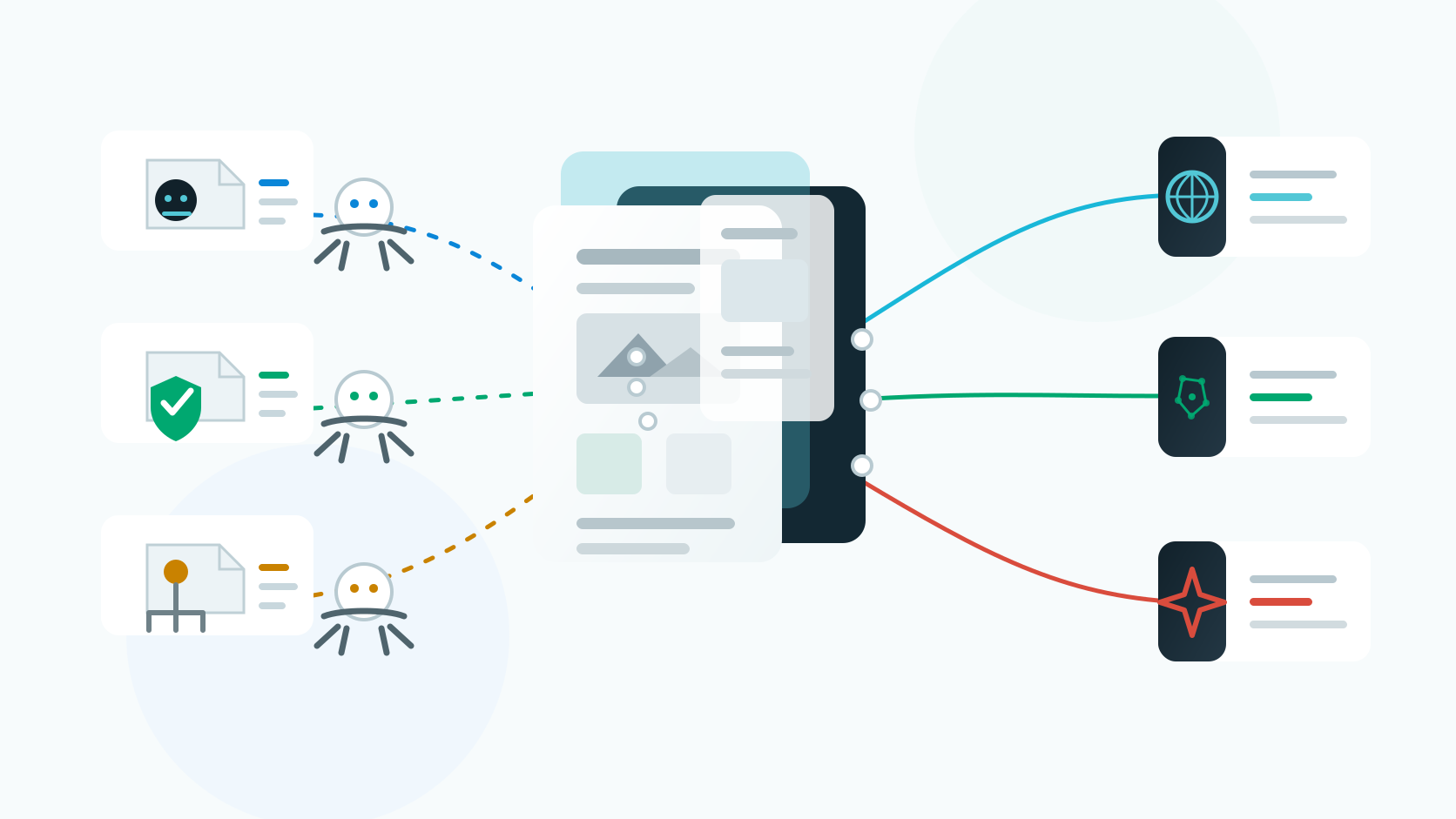
llms.txt is best understood as an editorial map for AI systems: a simple way to point models and agents toward the pages, definitions, guides and sources that best represent an entity, brand or topic. It carries no guarantee of appearing in ChatGPT, Gemini, Perplexity, Copilot or Google AI Overviews.
That distinction matters. In AEO, the problem is rarely just whether an answer engine can crawl a URL. The harder problem is whether it can identify which content is canonical, which page satisfies a specific intent, which definitions are quotable, and which trust signals reduce ambiguity. A good llms.txt helps at that context layer. A weak llms.txt just creates another stale file.
llms.txt is a human- and model-readable editorial index that prioritizes the content an AI system should use to understand a site, but it does not replace robots.txt, sitemaps, internal links, structured data or useful content.
What llms.txt is and what it is not
The original llms.txt proposal describes a Markdown file at the root of a domain that summarizes the site and links to key resources. Its value comes from selection. Instead of forcing a system to infer which URLs matter across hundreds of pages, the publisher offers a curated list of canonical pages, documentation, definitions, policies, use cases and clean resources.
It should not be sold as a ranking factor. Google’s documentation for AI features in Search says site owners do not need special AI text files or a dedicated schema type to appear in AI Overviews or AI Mode. For Google, the familiar fundamentals still matter: allowed crawling, indexing, accessible textual content, internal links, structured data that matches visible content and snippet eligibility.
The sensible use of llms.txt in AEO is therefore to add a context layer on top of a working technical SEO foundation.
Where it fits in an AEO strategy
Answer engines rely on retrieval, synthesis and citation. For a brand, that creates three needs: pages must be accessible, content must be easy to interpret, and the source must be trustworthy enough to support an answer. llms.txt mostly supports the second need: it organizes the corpus and signals which pieces deserve priority.
The file is especially useful for sites with documentation, glossaries, technical resources, comparisons, methodology pages or evergreen content. In those cases, a model or agent can benefit from a compact entry point that answers: what is this site, what does it cover with authority, which pages are pillars, and where is the full content available in a cleaner format?
The right stack: robots.txt, sitemap and llms.txt
A common mistake is blending their jobs together. Each file answers a different question.
- robots.txt expresses access preferences for crawlers. It can allow or block specific user agents, although compliance depends on the crawler unless technical controls are also used.
- A sitemap helps systems discover indexable URLs and understand the site’s publication architecture.
- llms.txt prioritizes resources that are useful for models and agents, with a reading structure closer to an editorial index than an exhaustive URL list.
- Structured data explains entities, relationships and attributes when it matches the visible page content.
- Internal links communicate hierarchy, semantic context and discovery paths for search engines, users and retrieval systems.
In AEO, the best practice is for these elements to reinforce one another. If a page appears as a primary resource in llms.txt, it should be indexable, internally linked, included in the sitemap when appropriate, and supported by clear signals of authorship, entity identity, update status when relevant and evidence.
What platforms say about access and context
Platforms do not treat every crawler the same way. OpenAI separates OAI-SearchBot, which is tied to search visibility in ChatGPT Search, from GPTBot, which is associated with crawling that may be used for training. Perplexity documents PerplexityBot as a crawler for surfacing and linking websites in its results. According to the same documentation, it does not crawl content for foundation-model training. Google keeps emphasizing that inclusion in its AI experiences starts with ordinary Search requirements.
Microsoft has taken a complementary path by exposing AI performance reporting in Bing Webmaster Tools, including citations, cited pages and grounding queries, then expanding visibility with intent, topic and citation-share signals. That reinforces an important idea: operational AEO is measured in layers that go beyond rankings and sessions.
Cloudflare adds another part of the discussion by reminding publishers that robots.txt expresses preferences but does not technically prevent access on its own. Its Content Signals work aims to separate uses such as search, answer grounding and training. For AEO strategy, the practical conclusion is straightforward: decide what you want to allow, document that decision and make sure your public files do not contradict each other.
How to create a useful llms.txt for AEO
1. Start with a canonical definition of the site
The first block should explain, in a few lines, what the site is, who it helps, what topics it covers and how it is positioned. Avoid vague claims such as “global leader” unless the site proves them. Answer engines need disambiguation.
2. Prioritize pillar pages
An llms.txt that links to every URL becomes a weaker sitemap. Select pages that satisfy important intents: definitions, methodology, guides, studies, product or service pages, documentation, policies and resources that could support a cited answer.
3. Include citable content that is easy to summarize
Answer engines favor clear fragments. Link to pieces that include short definitions, verifiable lists, comparisons, criteria, examples, FAQs and sources. If a page only contains generic sales copy, it probably does not deserve a place among the primary resources.
4. Separate access, training and answer visibility
Do not confuse allowing search visibility with allowing training. Review user agents such as OAI-SearchBot, GPTBot, ChatGPT-User, PerplexityBot, Googlebot, Bingbot and other crawlers that matter in your market. The policy should be deliberate: you may want maximum answer visibility while limiting certain training uses.
5. Maintain parity across languages
On a bilingual site, llms.txt should help systems discover equivalent resources in each language. If the site has a canonical guide in Spanish and another in English, both should appear with correct URLs, coherent hreflang and equivalent content. The AI system should not have to guess which version belongs to each market.
6. Add a full text version when the project supports it
For portals with substantial evergreen content, an export such as llms-full.txt can make it easier for an agent to read definitions, pillar pages, glossary entries and posts without relying on visual navigation. It does not replace public HTML, but it reduces friction when the goal is to answer with reliable context.
A practical llms.txt structure
- Site title and a short summary of the value proposition.
- Canonical pages for the market’s main questions.
- Glossary entries or stable definitions of important concepts.
- Methodology, editorial criteria or authority sources.
- Language-specific resources when the site is multilingual.
- Evergreen posts that reinforce topical clusters.
- A link to a full text export if one exists and is maintained.
- Contact, legal entity or company information when it helps disambiguate the source.
A useful llms.txt does not say “cite me”; it shows which content deserves to be understood first.
Mistakes that reduce its value
- Copying the full sitemap without editorial curation.
- Linking to pages blocked by robots.txt or marked noindex.
- Claiming authority that the visible content does not support.
- Forgetting equivalent versions in other languages.
- Failing to update the file when pillar pages, slugs, services or definitions change.
- Using llms.txt as an excuse to neglect titles, headings, internal links, schema and readability.
- Allowing AI search crawlers for visibility, then blocking them later with an unintended global rule.
AEO checklist before publishing it
- Check that linked URLs return 200 and are canonical.
- Confirm each important resource is internally linked from related pages.
- Review robots.txt so you do not accidentally block the bots you need for visibility.
- Make sure selected resources contain clear answers, quotable definitions and evidence.
- Verify hreflang on multilingual sites.
- Keep the file short, scannable and oriented toward context decisions.
- Schedule a review when new pillar pages are published or crawl policy changes.
Related internal resources
- llms.txt definition in the AEO glossary
- AEO/GEO methodology
- How to measure AI visibility over time
- How AI engines choose sources
Frequently asked questions
Does llms.txt improve Google rankings?
There is no solid basis for treating it as a ranking factor. Google says special AI files are not required for its Search AI features. Its value is in organizing context for models, agents and retrieval workflows that may use the file.
Can it replace a sitemap?
No. A sitemap supports discovery of indexable URLs. llms.txt selects priority resources for interpretation and context. A strong AEO site usually needs both, plus good internal linking.
Which pages should I include first?
Include pages an AI should read to explain who you are, what you do, which concepts you know deeply and which resources are canonical: the home page, methodology, glossary, pillar guides, technical resources and evergreen evidence-led content.
Should I allow every AI crawler?
It depends on your policy. The decision should separate search, user agents, answer grounding and training. To earn visibility in answer engines, avoid accidentally blocking the bots those platforms use to discover and cite pages.
Sources and further reading
- Google Search Central: AI features and your website
- OpenAI Developers: Overview of OpenAI Crawlers
- OpenAI Help Center: Publishers and developers FAQ
- Perplexity Docs: Perplexity Crawlers
- Bing Webmaster Blog: AI Performance in Bing Webmaster Tools
- Answer.AI: llms.txt proposal
- Cloudflare Docs: managed robots.txt and Content Signals