Google AI Search reporting in 2026: the AEO playbook for Search Console, AI Mode, and Bing AI Performance
A practical AEO playbook for Google's new AI Search controls and reporting, combining Search Console signals, Bing AI Performance, and citation-absorption research.
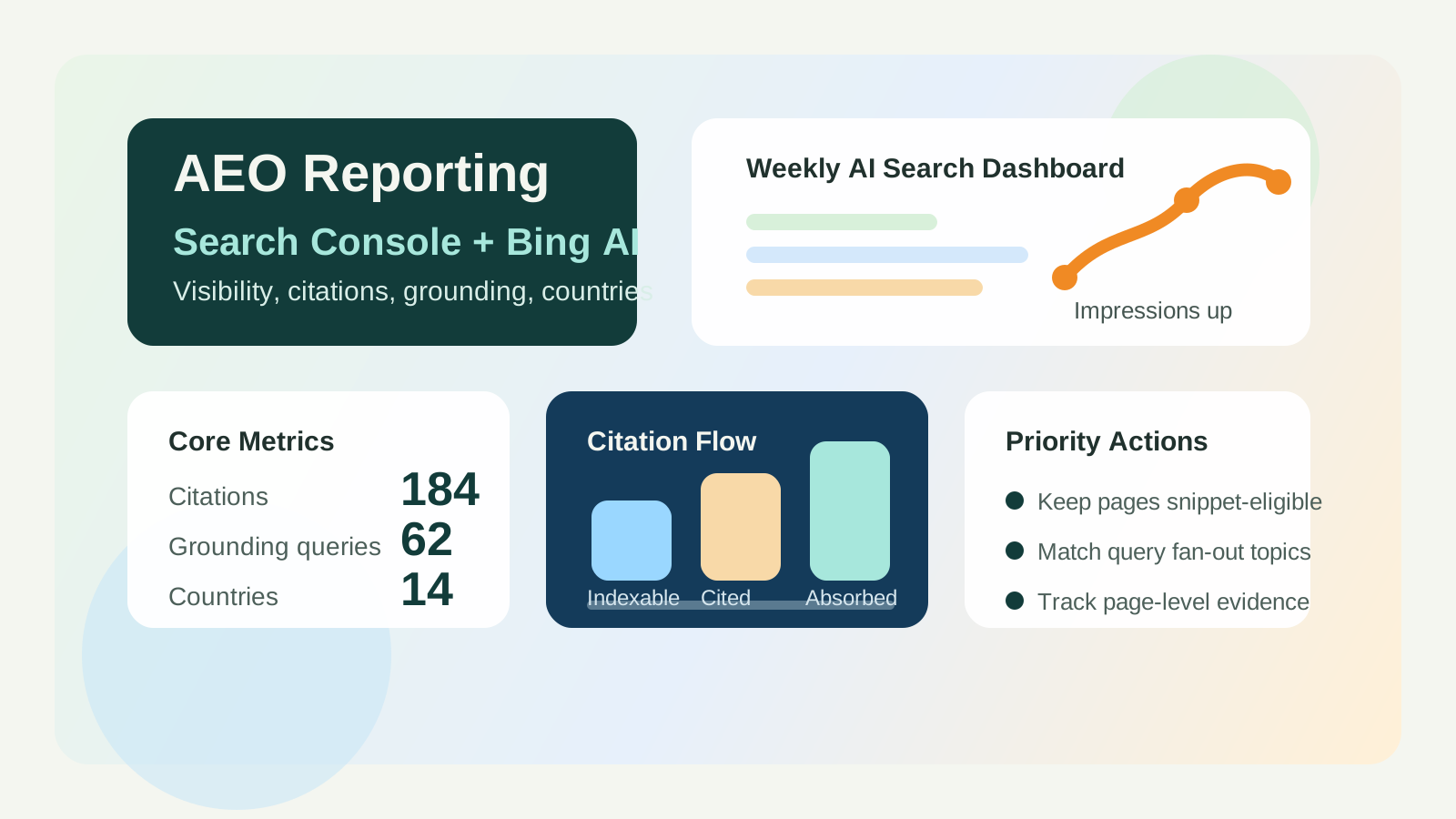
If you work in answer engine optimization, June 2026 gave you a more concrete operating environment. Google announced new AI Search controls and new reporting tests for some site owners in Search Console, while Bing's AI Performance dashboard is already exposing citation and grounding signals. Together, these updates move AEO away from screenshots and anecdotes toward repeatable measurement.
This matters for SEO too. The brands that win AI visibility are often the same brands that publish clearer service pages, stronger supporting articles, better entity signals, and more original evidence. AEO and SEO are increasingly one publishing and measurement system viewed through two interfaces: classic search results and AI-generated answers.
What changed on June 3, 2026
Google said AI Overviews had surpassed 2.5 billion monthly active users and AI Mode had passed 1 billion monthly users. More importantly for practitioners, Google said it was starting to test a new Search Console control for generative AI search features and new reporting that includes impressions, information about which pages appear in AI-generated responses, and country-level data for some UK site owners. That is the clearest sign yet that AI-search visibility is becoming a first-party reporting surface rather than a black box.
Google also continues to expand the user-side interface around source discovery. It has increased inserted links in AI answers, added site previews, and brought Preferred Sources into AI Overviews and AI Mode. For publishers and service brands, this means source selection and source familiarity are both becoming more important.
What Google is actually telling site owners
The most useful part of Google's guidance is that it is not mystical. Google Search Central says there are no special technical requirements for AI Overviews or AI Mode beyond standard Search eligibility. A page must be indexed and eligible to show a snippet if it is to appear as a supporting link. Google also explains that AI features may use query fan-out, issuing multiple related searches across subtopics and data sources before composing a response.
That detail changes content strategy. A page is no longer competing only for a single query. It may need to serve as evidence for adjacent subquestions, comparisons, definitions, objections, implementation details, and localized variants. In practice, that favors pages with clearer structure, explicit scope, stronger headings, and language that maps cleanly to how buyers actually ask questions.
Why Bing AI Performance belongs in the same workflow
Google's reporting is still early and limited. Bing is already further along in one critical area: native AI visibility metrics. Bing Webmaster Tools reports total citations, average cited pages, grounding queries, page-level citation activity, and visibility trends over time. Even if Google becomes the larger AI-search traffic source in your market, Bing currently offers one of the best operational windows into how answer engines retrieve and cite your site.
The practical implication is simple: use Google to understand eligibility, emerging reporting, and how AI search behavior is expanding; use Bing to study citations, page reuse, and retrieval language; use your own prompt tracking to connect those platform signals back to revenue-relevant journeys.
The AEO playbook for this new reporting era
1. Keep important pages indexable and snippet-eligible
This is the baseline. Review robots directives, noindex usage, snippet controls, canonicals, and any CDN or edge rules that could block crawling or reduce usable page text. Pages that are technically invisible or overly restricted cannot become reliable AI-answer sources, regardless of how well written they are.
2. Rewrite pages for query fan-out as well as head keywords
Audit your most important service and category pages against the subquestions a buyer would naturally ask. Add sections that define the service, explain who it is for, address alternatives, describe process, outline limits, and answer common objections. This makes the page more reusable when an answer engine expands the original prompt into several retrieval steps.
3. Publish source-first pages
Google's latest guidance still favors unique, non-commodity content. The AEO version of that rule is source-first publishing: pages that provide original method detail, benchmarks, examples, decision criteria, comparisons, or evidence a model can safely reuse. Thin summaries are easy to replace. Source assets are harder to ignore.
4. Treat source familiarity as a strategic asset
Preferred Sources and richer source labels matter because AI search is also a navigation layer. If users already know your brand, subscribe to your expertise, or repeatedly choose your site, platform features that foreground familiar sources can reinforce your visibility. This does not replace SEO. It rewards brand memory and repeat trust on top of SEO.
5. Build a combined reporting stack now
Do not wait for perfect dashboards. Start combining three layers: Search Console and analytics for clicks, impressions, and conversions; Bing AI Performance for citations and grounding phrases; and a prompt portfolio that records recommendation rate, citation rate, cited URLs, competitor presence, and factual errors across engines. The companies that start this history early will have a better benchmark when Google's AI reporting expands.
6. Measure citation absorption as well as citation presence
A recent April 2026 GEO paper argues that visibility has two stages: citation selection and citation absorption. In other words, a page might be cited without materially shaping the final answer. That is a useful distinction. Track whether your page is linked and also whether its language, facts, or framing are actually reflected in the answer. Pages that consistently influence the answer are the pages to expand, update, and internally reinforce.
7. Audit source quality before you scale content production
A May 2026 citation audit found evidence of AI-generated sources in roughly 16 percent of cited generative-search sources across the engines studied. That is a warning for AEO teams. Publishing more pages is not enough if your supporting ecosystem is thin, stale, or low-trust. Strong answer visibility depends on source reliability: your site, your structured data, your external profiles, and the third-party pages that repeatedly frame your category.
The SEO upside of this AEO work
This playbook improves AI-answer visibility, crawl clarity, internal linking opportunities, long-tail coverage, content usefulness, and conversion intent. Google explicitly says AI features still rely on foundational SEO, and it has also said clicks from AI Overviews can be higher quality. So the right AEO work upgrades SEO around the kinds of questions people increasingly ask.
A 30-day operating plan
- Week 1: audit indexability, snippet eligibility, entity consistency, and the current prompt portfolio for your core offers.
- Week 2: improve the pages most likely to become citation candidates by adding scope, methodology, comparisons, examples, and next-step clarity.
- Week 3: map Bing grounding queries and cited pages against your keyword clusters, internal links, and content gaps.
- Week 4: rerun the prompt set, log citation absorption, compare assisted-conversion signals, and choose the next content update from the data.
The most important AEO shift in June 2026 is that site owners started to get better native visibility into how answers are built.
Answer Engines Optimization helps companies turn AI-search visibility into a measurable operating system. If you want to understand how your brand appears in AI Overviews, AI Mode, ChatGPT, Copilot, Perplexity, and other answer surfaces, start with an AI visibility audit and build a reporting stack that links citations to content decisions and conversions.
Sources and further reading
- Google Search Central: AI features and your website
- Google Search Central Blog: Top ways to ensure your content performs well in Google's AI experiences on Search
- Google Blog: New opportunities, control and insights for website owners
- Google Blog: New ways to find your favorite sources and original content in AI Search
- Google Blog: How AI Mode is changing the way people search in the U.S.
- Bing Webmaster Blog: Introducing AI Performance in Bing Webmaster Tools Public Preview
- Bing Search Blog: Elevating the Role of Grounding on the AI Web
- arXiv: Synthetic Sources?: Auditing Generative Search Engine Citations for Evidence of AI-Generated Sources
- arXiv: From Citation Selection to Citation Absorption