Claim fidelity in AEO: how to stop AI engines misquoting your content
A practical guide to auditing whether AI-generated answers interpret, summarize and cite a brand's most important claims accurately.
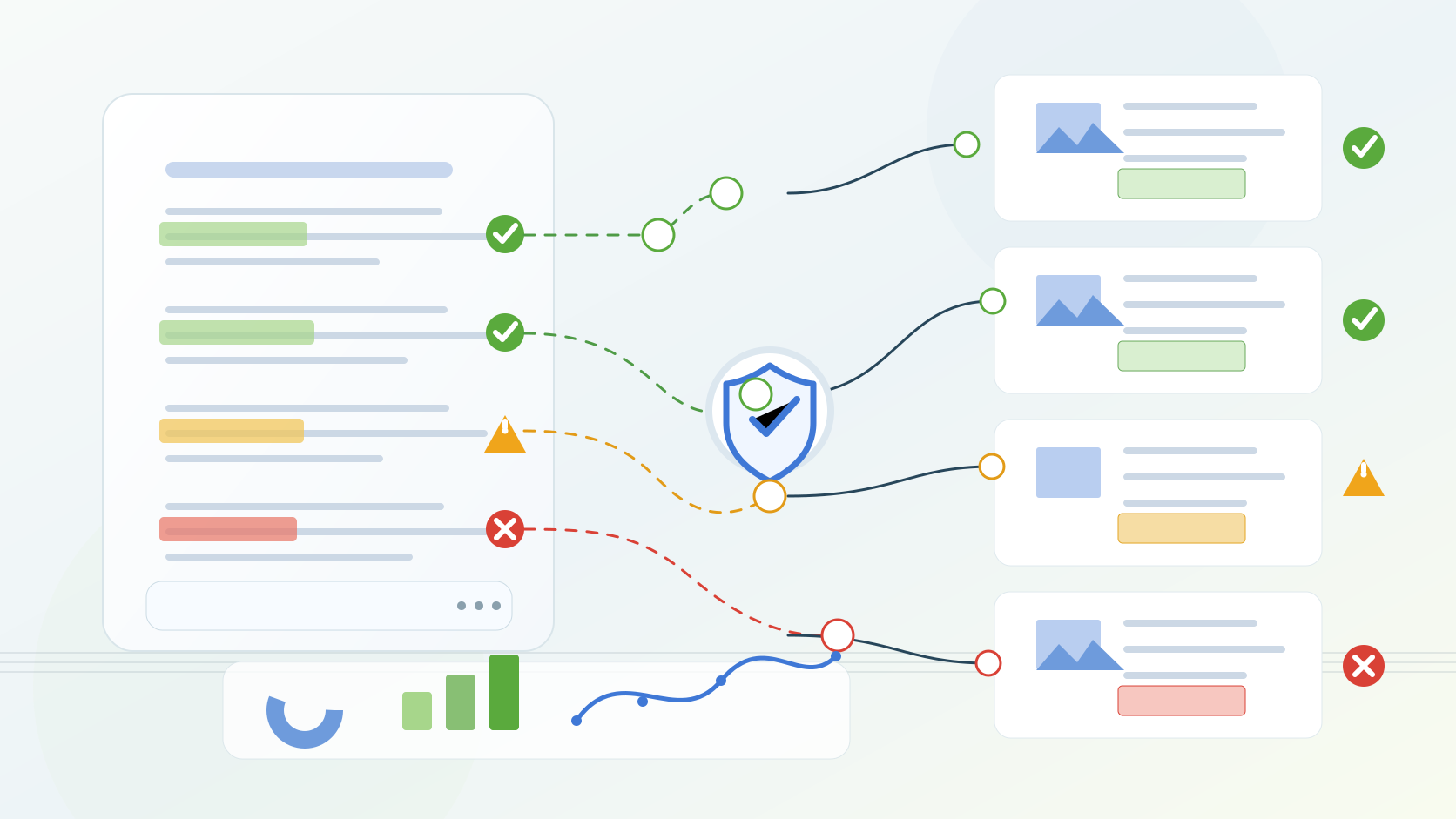
Winning a citation in ChatGPT, Gemini, Perplexity, Copilot or AI Overviews is not enough if the answer misrepresents what the source actually says. In AEO, a useful citation has to pass two tests: the engine selected the right page, and the generated claim is genuinely supported by that page.
That second test is often missed. Many teams measure mentions, links and share of voice, but they do not check whether the answer attributes data the page does not contain, exaggerates a commercial promise, ignores a limitation or blends several sources into a conclusion nobody published. The result is risky visibility: the brand appears, but the meaning attached to it is unstable.
Claim fidelity in AEO measures whether each important sentence in a generated answer is explicitly, verifiably and unambiguously supported by the cited source.
Why fidelity matters more than a citation count
A citation can look like a win in an AI visibility report and still be weak commercially or reputationally. If an engine cites a methodology guide to justify a price that never appears there, the source is not doing its job. If it cites a product page to recommend an excluded use case, the brand is exposed to an incorrect recommendation.
Research on AI Overviews shows why source selection and claim fidelity should be measured separately. A longitudinal arXiv study analyzed more than 55,000 queries and almost 100,000 atomic claims, finding that a meaningful share of claims were not supported by the cited pages. It also found that many cited domains did not appear in classic first-page organic results.
The practical AEO lesson is simple: ranking is not enough, and being cited is not enough. Content has to reduce the chance of misinterpretation when an engine retrieves, synthesizes and links to it.
What to review in a claim fidelity audit
A claim fidelity audit checks whether each important claim has visible support in a specific source, however convincing the answer sounds. To do that, break the generated answer into small units and classify each one.
- Supported: the cited source says the same thing clearly, with the same scope and no contradiction.
- Partially supported: the source contains part of the claim, but conditions, context or limits are missing.
- Inferred: the AI draws a plausible conclusion, but the source does not state it directly.
- Blended: the sentence combines information from several sources and attributes the result imprecisely.
- Unsupported: the claim does not appear in the cited source or contradicts what the page says.
- Outdated: the claim may once have been accurate, but the page no longer reflects the current product, service, policy or method.
The claim inventory worth controlling
Not every sentence on a website needs the same editorial control. Prioritize claims that affect trust, comparison, eligibility, pricing, scope, safety, methodology or recommendation. If an AI system could use a sentence to include or exclude you from a shortlist, that sentence needs clear support.
- Owned definitions: what AEO, AI visibility, citation rate or recommendation rate mean in your methodology.
- Commercial claims: which services are offered, for whom, in which markets and with which limits.
- Original data: sample size, aggregated period, calculation method, exclusions and caveats.
- Comparisons: criteria used to say an option is better, cheaper, faster or more suitable.
- Trust evidence: certifications, external sources, reviews, cases, policies and evidence pages.
- Sensitive content: health, finance, legal, safety, availability, pricing or contractual conditions.
How to write pages that reduce bad citations
The answer is to remove ambiguity while keeping sentences natural. Google explains that its generative features use retrieval, grounding and query fan-out: the system can search related subtopics and select supporting pages that differ from what a user would see in classic search. A page built for AEO has to hold up inside that process.
- Put the main claim near the top and repeat it only when it adds precision.
- State the exact scope: market, customer type, use case, condition, exclusion or aggregated period when needed.
- Separate facts from opinions: “we measure X this way” should not sit in the same sentence as “we are the leader”.
- Add explicit limits: what the data does not prove, when the service does not apply or what changes the recommendation.
- Link to the methodology page, primary source or evidence page that supports the claim.
- Avoid hiding critical information in images, inaccessible tabs, PDFs without an HTML summary or fragile scripts.
- Keep structured data aligned with visible text; markup should not promise something the page does not say.
Technical controls that affect fidelity
Beyond the writing, fidelity depends on what each system can retrieve. For Google, a page that wants to appear as a supporting link in AI Overviews or AI Mode must be indexed and eligible to show a snippet. Google's robots meta documentation also explains that directives such as nosnippet or max-snippet limit direct use of content in those experiences.
That turns technical directives into editorial decisions. If a page is strategic and citable, it should allow crawling, indexing and enough snippet access. If it contains outdated, private, duplicated or legally sensitive content, the better answer may be noindexing it, limiting snippets or replacing it with a clearer public version.
A practical audit workflow
- Choose a stable prompt portfolio where your brand, product, category or methodology should appear.
- Run multiple checks per engine, because citations can vary across runs and models.
- Extract the important claims from each generated answer and assign each one to a cited source.
- Classify each claim as supported, partial, inferred, blended, unsupported or outdated.
- Record the URL that should have supported the claim better, even if it was not cited.
- Fix pages that create commercial, legal or reputational risk first.
- Remeasure after updating content, internal links, structured data or crawl directives.
Example: from ambiguous claim to citable source
A service page says: “we help B2B companies improve AI visibility.” A generated answer might turn that into: “the agency guarantees more ChatGPT citations for B2B companies.” The page does not support that promise. Part of the problem sits in the source, which fails to separate scope, method and limits.
A more faithful version would explain what is audited, which engines are checked, which metrics are measured, what is not guaranteed and how actions are prioritized. Then, if an AI engine cites the source, it has less room to invent a guarantee or turn a methodology into an outcome promise.
Metrics to add to an AEO report
- Faithful citation rate: the share of citations where the claim is supported without omitting important nuance.
- Unsupported claim rate: the share of important sentences the cited source does not prove.
- Source blending rate: how often the AI combines sources and attributes the conclusion poorly.
- Claim risk: potential impact if an answer exaggerates price, scope, guarantee, availability or evidence.
- Corrective URL: the page that should exist or be improved to support the claim more clearly.
- Correction lag: how long it takes the system to reflect changes after content and technical signals are updated.
Related internal resources
- How to create citable evidence pages for answer engines
- How to build a prompt portfolio for AI visibility
- Citation is not recommendation: the AEO metric that decides whether AI visibility sells
- Why AI engines cite different sources for the same question
Frequently asked questions
Is claim fidelity an SEO metric or an AEO metric?
It is primarily an AEO metric because it evaluates how a generative answer uses a source. It also improves classic SEO work because it forces better clarity, structure, internal linking, trust and content maintenance.
Can an incorrect citation be fixed only by editing copy?
Not always. It may require a new evidence page, clearer internal links, consistent structured data, snippet changes, outdated content cleanup or better separation between commercial claims and methodology.
Should each answer engine be measured separately?
Yes. Google AI Overviews, AI Mode, ChatGPT, Perplexity, Gemini and Copilot can retrieve different sources and synthesize answers differently. A claim can be faithful in one engine and problematic in another.
Does llms.txt improve claim fidelity?
It can help as an editorial index if it points to the most important pages, but it does not replace visible, crawlable and verifiable content. Fidelity improves when the primary source states the claim and its limits clearly.
Sources and further reading
- Google Search Central: AI features and your website
- Google Search Central: optimizing for generative AI features on Google Search
- Google Search Central: robots meta tag, data-nosnippet and X-Robots-Tag specifications
- Google Search Central: creating helpful, reliable, people-first content
- arXiv: Measuring Google AI Overviews: Activation, Source Quality, Claim Fidelity, and Publisher Impact
Conclusion
The next stage of AEO is appearing accurately as well as more often. A mature strategy measures whether generated answers cite suitable sources, whether the claims are supported and whether the site's pages reduce ambiguity instead of amplifying it.
When a brand audits claim fidelity, content becomes trust infrastructure: easier to retrieve, easier to cite and less vulnerable to inaccurate summaries.