AEO in 2026: how to become the answer AI engines can cite
A practical playbook for turning your website, brand facts and external proof into evidence that ChatGPT, Gemini, Copilot, Perplexity and AI search systems can use.
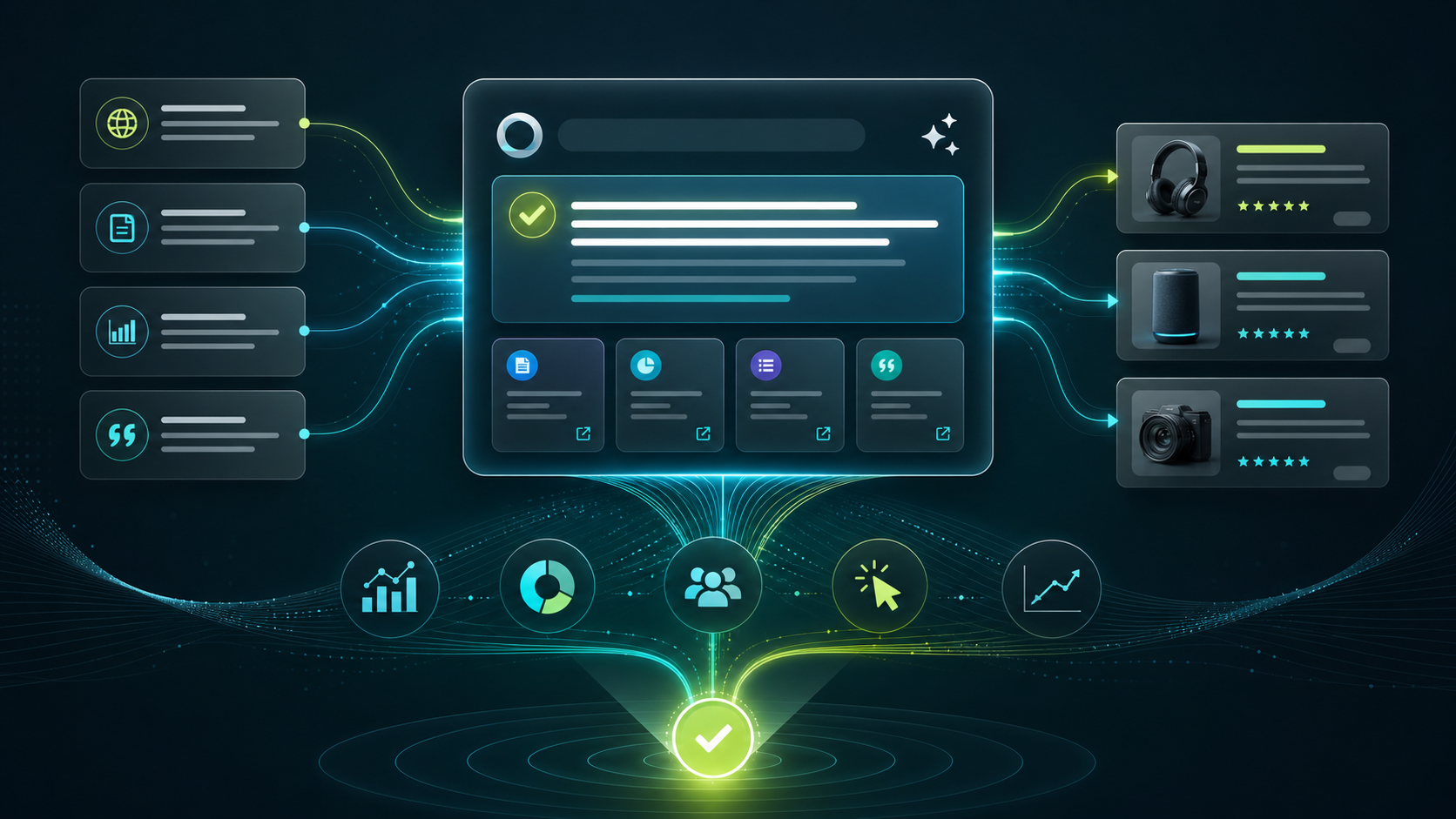
SEO is still here; the important shift in 2026 is that a growing share of discovery now happens before a click, inside an answer. A buyer asks ChatGPT for a shortlist, compares providers in Gemini, checks a product through AI shopping research, sees a Copilot summary in Bing or follows a Perplexity citation. In that journey, visibility goes beyond the blue link: it means being named, accurately described, cited and recommended when the user is still forming the decision.
That is the working territory of Answer Engine Optimization, or AEO. Good AEO does not try to trick a model. It improves the evidence environment around a company so that AI systems can understand what the company does, when it is relevant, why it should be trusted and which sources support those claims. The companies that win are usually not the ones with the loudest copy. They are the ones whose facts are easiest to retrieve, verify and synthesize.
What changed in the market
Several recent signals point in the same direction. Google explains that AI Overviews and AI Mode can use query fan-out, issuing multiple related searches across subtopics and data sources before composing an answer. OpenAI has expanded ChatGPT search and product discovery experiences, including shopping research that asks clarifying questions, reviews sources and builds a buyer guide. Bing Webmaster Tools now exposes AI Performance data in public preview, including how content appears in Copilot and AI-generated summaries. Researchers are also auditing generative search citations because the quality and provenance of cited sources is becoming a public-interest issue.
For marketers and company leaders, the implication is simple: AI visibility is becoming measurable, competitive and operational. It is not enough to publish generic thought leadership and hope a model notices. You need a system for mapping prompts, sources, entities, claims, citations and competitors over time.
The new unit of visibility is the answer
Classic SEO usually starts with a page and asks how that page ranks. AEO starts with an answer and asks what evidence shaped it. When someone asks for the best software, agency, clinic, manufacturer, consultant, hotel, university program or local service for a specific need, the answer may include a ranked shortlist, a comparison, a warning, a citation panel or a buying guide. The page still matters, but it is one component inside a larger answer system.
This is why many teams misread the opportunity. They look only for referral traffic from AI platforms. That traffic matters, but it undercounts influence. A model can recommend a brand, correct a misconception, compare features or mention a trusted source without sending an immediate click. The business impact may appear later as branded search, direct visits, higher conversion rates, sales-qualified conversations or fewer objections during the buying process.
What AI engines need from your website
Your website should behave like a reliable source file for your company. That means clear entity facts: legal name, brand name, locations, markets served, languages, founders or leadership where relevant, product or service categories, customer types, pricing model if public, contact options and proof points. These facts should be consistent across your home page, service pages, about page, schema markup, profiles, listings and external references.
Then come citable explanations. A page that says "we help companies grow with AI" is too vague. A citable page explains the problem, the audience, the use cases, the method, the limits, the evidence and the next step. It gives an AI system language it can reuse without inventing. It also gives humans enough substance to trust the recommendation.
- Define each service in plain language before using acronyms.
- State who the service is for and who it is not for.
- Document your methodology as well as your benefits.
- Show proof through examples, case notes, benchmarks, process artifacts or client outcomes where confidentiality allows.
- Keep important content indexable and snippet-eligible unless there is a deliberate reason to restrict it.
- Use structured data to reinforce entities, services, authorship, organization facts and breadcrumbs.
What AI engines need outside your website
AI systems do not evaluate your company from your website alone. They also encounter directories, review platforms, partner pages, podcasts, social profiles, news articles, community discussions, documentation, app marketplaces, analyst reports, local listings and comparison pages. If those sources are thin, contradictory or outdated, the model has to resolve ambiguity. If they are consistent and specific, the model has a stronger basis for inclusion.
This is where AEO and digital PR meet. The goal is legitimate presence in the sources that already influence your category. For a B2B service, that might mean partner directories, expert interviews, high-quality educational pages, comparison resources and founder-led explanations. For ecommerce, it may include product feeds, reviews, availability data, category guides and third-party product coverage. For local services, it includes location consistency, reviews, local citations and pages that connect service intent with geography.
A practical AEO operating model
The first step is measurement. Build a prompt portfolio that reflects how customers ask for help: informational prompts, comparison prompts, "best provider" prompts, problem-solution prompts, local prompts, budget prompts, risk prompts and alternative prompts. Run them across the engines that matter for your market. Record whether your brand appears, whether it is recommended, which competitors appear, what sources are cited, what claims are made and what is wrong or missing.
The second step is source mapping. Group the sources that repeatedly shape answers. Some will be your own pages. Some will be competitors. Some will be third-party pages. Some will be missing opportunities. This map tells you where to improve content, where to correct entity data, where to earn legitimate references and where technical access is blocking discovery.
The third step is intervention. Improve the pages that should become citation candidates. Create pages for high-intent questions that are currently answered by competitors. Clarify service definitions. Add comparison logic without attacking competitors. Update external profiles. Make evidence easier to extract. Review robots directives, snippets and crawler access. Then measure again instead of assuming the work has changed the answer.
The conversion layer: AEO should generate demand as well as mentions
AEO becomes commercially valuable when the path from answer to action is clear. If an AI engine cites a page, that page should help a buyer move forward. It should answer the next question, reduce uncertainty and offer a relevant conversion path. For a service business, that might be an AI visibility audit, a category source map, a consultation or a diagnostic report. For a product business, it may be a comparison tool, availability information, implementation guide or pricing explainer.
This is why we treat AEO as a funnel. At the top, the brand needs to be discoverable in category answers. In the middle, it needs to be evaluated fairly against alternatives. At the bottom, it needs pages that support decision-making: proof, process, pricing context, objections, implementation and contact. The best article informs and also becomes part of the evidence system that future answers can cite.
A 30-day priority plan
- Week 1: audit AI visibility across a prompt portfolio and collect cited sources, competitors, claims and errors.
- Week 2: fix technical blockers, snippet restrictions, inconsistent entity facts and weak schema on the pages that matter most.
- Week 3: publish or improve citable pages for core services, use cases, comparisons and high-intent questions.
- Week 4: update external profiles, pursue legitimate category sources and repeat measurement to identify movement.
The companies that start early will build an evidence advantage. Their facts will be clearer, their pages more useful, their external source graph stronger and their measurement history deeper. In a market where AI engines are becoming an interface for research, comparison and purchase, that advantage compounds.
AEO builds a body of evidence that makes your company the safest, clearest and most useful answer to recommend.
Answer Engines Optimization helps companies audit, measure and improve their visibility in AI-generated answers. If you want to know how your brand appears in ChatGPT, Gemini, Copilot, Perplexity and Google AI experiences, start with an AI visibility audit and turn the findings into a practical source, content and conversion roadmap.
Sources and further reading
- Google Search Central: AI features and your website
- OpenAI: Introducing ChatGPT search
- OpenAI: Introducing shopping research in ChatGPT
- OpenAI Help Center: Shopping with ChatGPT Search
- Bing Webmaster Blog: Introducing AI Performance in Bing Webmaster Tools Public Preview
- arXiv: Synthetic Sources? Auditing Generative Search Engine Citations